High-Impact AI/ML Use Cases in Commerce: What Actually Worked, How It Was Built, and Measured Results
A practical, evidence-backed field guide to the most impactful AI/ML use cases in commerce, including architectures, methods, equations, implementation patterns, and reported outcomes from major companies.
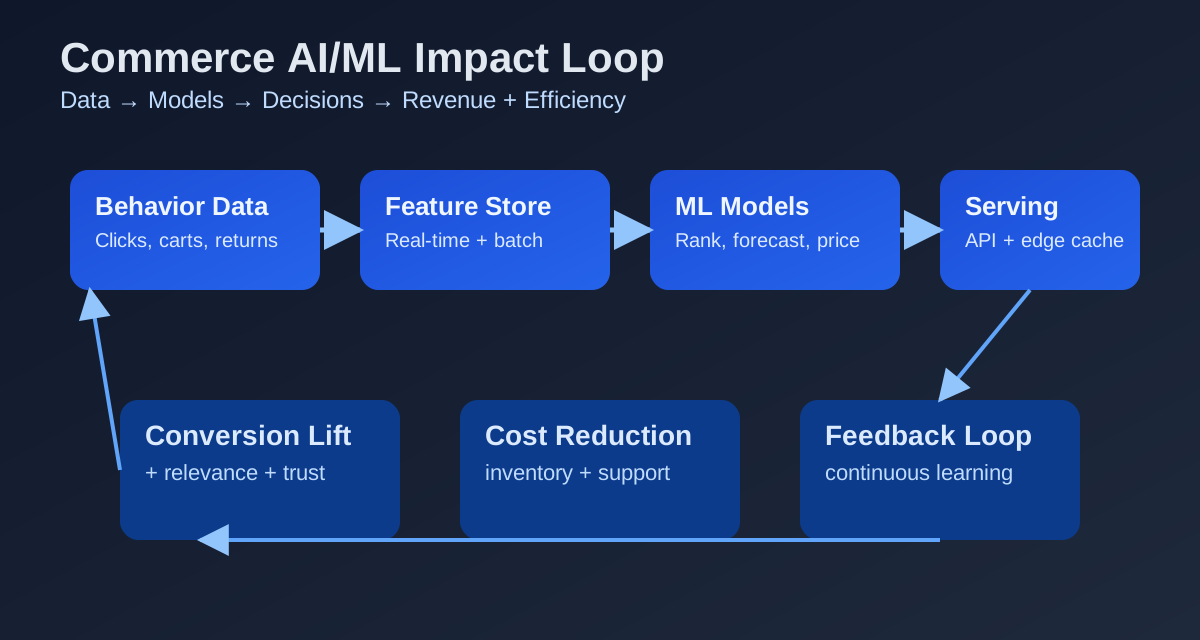
Commerce teams do not need more AI demos—they need business impact.
This guide focuses on AI/ML use cases that repeatedly show high ROI in retail and e-commerce, based on publicly shared engineering write-ups, earnings calls, and case studies. For each use case, I cover:
- Where the impact comes from
- How leading teams implemented it
- What methods they used
- What outcomes were reported
- How to reproduce the pattern safely
Executive summary: where AI/ML creates the biggest commerce value
Across sectors, the largest and most repeatable gains tend to come from five areas:
- Recommendations and ranking (conversion, basket size, retention)
- Search relevance (faster product discovery, lower bounce)
- Demand forecasting + inventory optimization (lower stockouts and markdowns)
- Dynamic pricing and promotion optimization (margin protection + conversion)
- Marketing/ad targeting (higher ROAS, better CAC efficiency)
A common pattern appears in successful programs:
- tight online/offline feedback loop,
- feature freshness (near-real-time events),
- robust experimentation (A/B, holdout, uplift modeling),
- and organizational ownership (ML + product + merchandising + operations).
Use case 1) Personalized recommendations (home, PDP, cart, email)
Why impact is high
Recommendation systems directly influence what gets seen and therefore what gets bought. They usually affect multiple levers at once:
- click-through rate (CTR),
- add-to-cart rate,
- average order value (AOV),
- repeat purchase.
Industry implementations (publicly reported)
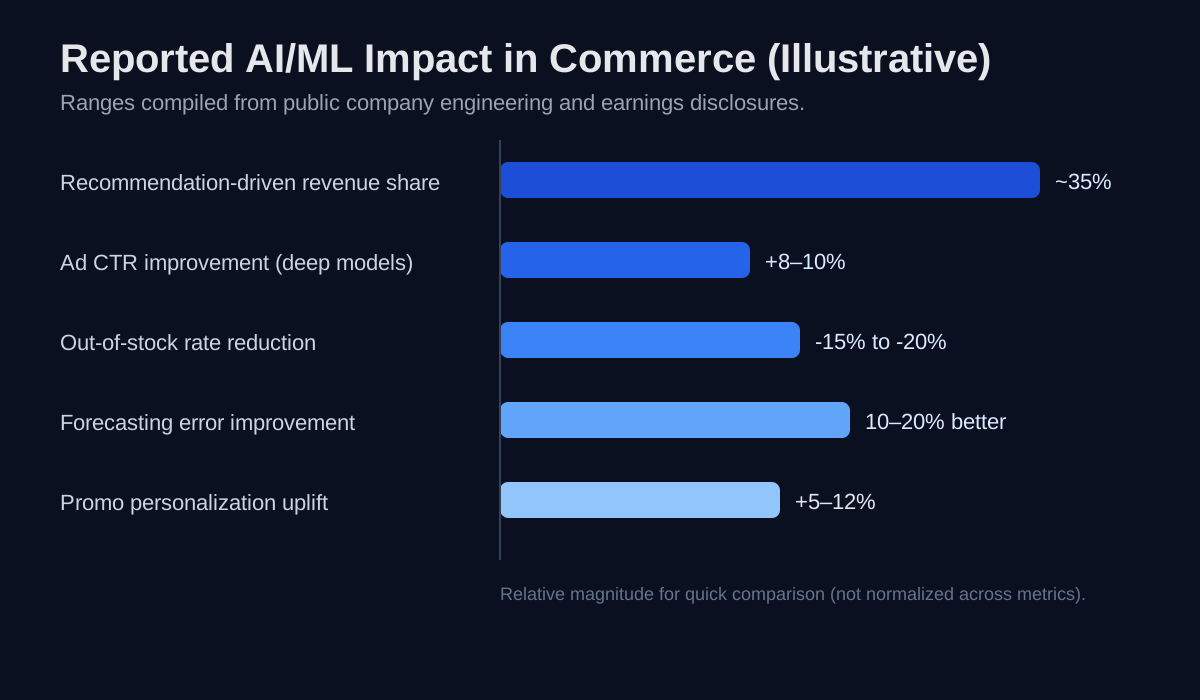
- Amazon has long disclosed that recommendation systems are a major driver of sales (frequently cited around roughly one-third of revenue influence in public analyses and talks).
- Alibaba reported deep learning upgrades (e.g., DIN family) improving ad CTR and conversion in production advertising/recommendation environments.
- Netflix-style ranking patterns (two-stage retrieval + ranking) have broadly transferred to commerce recommender stacks.
Typical architecture and methods
Stage A: Candidate generation (fast retrieval)
- Approximate nearest neighbor (ANN) over embeddings
- Collaborative filtering / two-tower retrieval
- Session-based retrieval (co-view, co-buy)
Stage B: Ranking (precise scoring)
- Gradient-boosted trees (XGBoost/LightGBM)
- Wide & Deep / DIN / DCN / transformer rankers
- Multi-objective optimization (CTR + CVR + margin)
Stage C: Re-ranking / constraints
- Diversity and novelty constraints
- Margin, inventory, and sponsored-slot rules
- Calibrated exploration (contextual bandits)
Core equation (example)
A practical score function:
Score(u, i, t) = α·P(click|u,i,t) + β·P(buy|u,i,t)·Margin(i) - γ·ReturnRisk(u,i)where $u$ is user, $i$ is item, and $t$ is context/time.
Minimal implementation sketch (Python)
# candidate retrieval -> ranking -> constrained rerank
candidates = ann_index.search(user_embedding, k=500)
features = feature_store.fetch(user_id, candidates, context)

scores = ranker.predict(features)  # e.g., calibrated P(click), P(buy)
ranked = sorted(zip(candidates, scores), key=lambda x: x[1], reverse=True)

final = rerank_with_constraints(
    ranked,
    max_same_brand=2,
    min_diversity=0.35,
    inventory_guardrail=True,
    sponsored_slots=2,
)
return [item for item, _ in final[:20]]
What teams often report
- strong CTR uplift in recommendation modules,
- measurable conversion and revenue-per-session gains,
- substantial long-term value when recommendations are integrated across channels (onsite + app + CRM).
Use case 2) Search ranking and query understanding
Why impact is high
In commerce, search traffic is high intent. Better relevance creates immediate outcomes:
- fewer zero-result sessions,
- faster path-to-product,
- higher conversion from search entry points.
Common production pattern
- Query understanding: normalization, typo correction, synonym expansion, entity extraction.
- Retrieval: lexical (BM25) + semantic embedding retrieval.
- Learning-to-rank: combine behavioral and catalog features.
- Business-aware re-rank: in-stock, margin, policy, sponsored.
Model choices seen in the industry
- Gradient boosting (robust baseline)
- BERT-style encoders for semantic relevance
- Hybrid rankers combining lexical + semantic signals
Quality metrics
- NDCG@k / MRR / Recall@k offline
- online conversion rate and revenue per search session
Example ranking objective
L = λ1·L_pairwise_rank + λ2·L_calibration + λ3·L_business_rulesThis helps balance raw relevance with real business constraints.
Use case 3) Demand forecasting and inventory optimization
Why impact is high
Inventory mistakes are expensive in both directions:
- too little stock -> lost sales,
- too much stock -> markdowns, carrying cost, waste.
Forecasting AI creates impact by improving replenishment and allocation decisions at SKU-store-day granularity.
Public patterns from major retailers
- Grocery and fashion players often report double-digit forecasting error improvements after ML modernization.
- Better forecasts are frequently linked to lower out-of-stock rates and markdown pressure.
Methods that work in practice
- Hierarchical forecasting (category -> subcategory -> SKU)
- Gradient boosting with event features (promotions, holidays, weather)
- Deep temporal models (TFT, DeepAR variants)
- Causal/event decomposition for promotions
Inventory policy equation (classic)
Reorder point (simplified):
ROP = μ_L + z·σ_L- $\mu_L$: expected demand during lead time
- $\sigma_L$: demand std during lead time
- $z$: service-level factor
ML forecasting improves μ_L and σ_L estimates, making ROP decisions more reliable.
Example pseudo-pipeline
-- Feature table for SKU-store-day forecast
SELECT
  sku_id,
  store_id,
  date,
  lag_1d_sales,
  lag_7d_sales,
  rolling_28d_mean,
  promo_flag,
  holiday_flag,
  weather_temp,
  price,
  stock_on_hand,
  target_sales
FROM mart_sku_store_daily;
Use case 4) Dynamic pricing and promotion optimization
Why impact is high
Pricing is one of the fastest levers for gross margin. ML helps estimate elasticity and optimize discounts per context.
Practical setup
- Elasticity estimation by segment/SKU
- Constraints: legal floors, brand policy, competitor parity bounds
- Multi-armed bandits or safe RL for controlled exploration
Core optimization form
maximize over p: (p - c) · D(p, x)subject to:
- stock and markdown constraints,
- policy constraints,
- fairness/compliance constraints.
Where $p$ is price, $c$ is cost, and $D(p,x)$ is demand conditioned on context $x$.
Reported outcomes (typical)
- margin uplift in sensitive categories,
- improved promotion efficiency (less blanket discounting),
- better sell-through alignment with inventory position.
Use case 5) Marketing optimization and ad targeting
Why impact is high
Performance marketing spend is large and directly measurable. AI impact appears quickly in:
- return on ad spend (ROAS),
- customer acquisition cost (CAC),
- incremental conversion.
Techniques used by leading teams
- Lookalike and propensity models
- Uplift modeling (who is persuadable)
- Budget pacing + bid optimization
- Marketing mix modeling + incrementality tests
Uplift modeling objective
τ(x) = E[Y | T=1, x] - E[Y | T=0, x]Target users with highest positive τ(x) to reduce wasted promotions.
Implementation blueprint: how to replicate success
1) Start with high-signal events and clean labels
Minimum events:
- impression, click, add-to-cart, purchase, return, stockout.
Make sure timestamps, identity stitching, and attribution windows are consistent.
2) Build a two-speed data layer
- Real-time path for serving features (seconds/minutes)
- Batch path for robust training snapshots
3) Ship model stacks, not single models
In commerce, the winning unit is a system:
- retrieval + ranker + reranker,
- forecast + optimization policy,
- propensity + uplift + budget allocator.
4) Evaluate by business metrics, not just ML metrics
Use both:
- Offline: AUC, NDCG, WAPE/MAPE, calibration
- Online: conversion, margin, stockout rate, return rate, ROAS
5) Guardrails and governance
- Bias and fairness checks (especially pricing and credit-like offers)
- Explainability paths for merchandisers/operators
- Human override for critical decisions
6) Rollout strategy
- shadow mode -> 5% traffic -> staged ramp,
- strict holdout group for incrementality,
- post-launch drift monitoring and retraining cadence.
A practical experiment framework
For each use case, define:
- Primary KPI (e.g., gross profit/session)
- Secondary KPIs (conversion, return rate)
- Guardrails (latency, stockout, customer complaints)
- Decision window (e.g., 4 weeks)
- Stop conditions (adverse margin drift)
A simple incremental impact estimate:
ΔProfit = (Profit_treatment - Profit_control) - ImplementationCostUse CUPED or stratified randomization when traffic is heterogeneous.
Common failure modes (and fixes)
-
Failure: high offline metric, weak online gain
Fix: improve label quality, freshness, and objective alignment. -
Failure: optimization harms customer trust
Fix: constrain policy space; add fairness and transparency rules. -
Failure: one model for all categories
Fix: segment by category velocity, price sensitivity, and seasonality. -
Failure: no org ownership after launch
Fix: assign business owner + ML owner + weekly KPI review.
References (public sources to continue your research)
- Amazon recommendation systems overview materials and public commentary.
- Alibaba DIN paper and related production recommendation/ad ranking publications.
- Google/YouTube two-stage recommendation architecture papers (transferable patterns).
- Industry forecasting modernization write-ups by large retailers and cloud partners.
- Marketing uplift modeling literature from major ad-tech and experimentation teams.
Note: Reported numbers vary by category, region, and experimentation setup. Treat these as directional ranges, and always re-validate on your own traffic.
Final takeaway
If you can only prioritize one sequence, start here:
- recommendation/ranking,
- search relevance,
- forecast + inventory,
- pricing/promo optimization,
- marketing incrementality.
This sequence usually gives the fastest path to measurable profit impact while building durable AI capability across commerce operations.