Post-Training for LLMs: A Simple, Practical Guide for Developers
An easy-to-understand guide to post-training with equations, code, charts, and workflow diagrams for real-world engineering teams.
If pretraining gives a model raw language ability, post-training teaches it to behave like a useful assistant.
In plain words, post-training is where we make a base model:
- follow instructions,
- prefer better answers,
- avoid unsafe behavior,
- and stay reliable under production constraints.
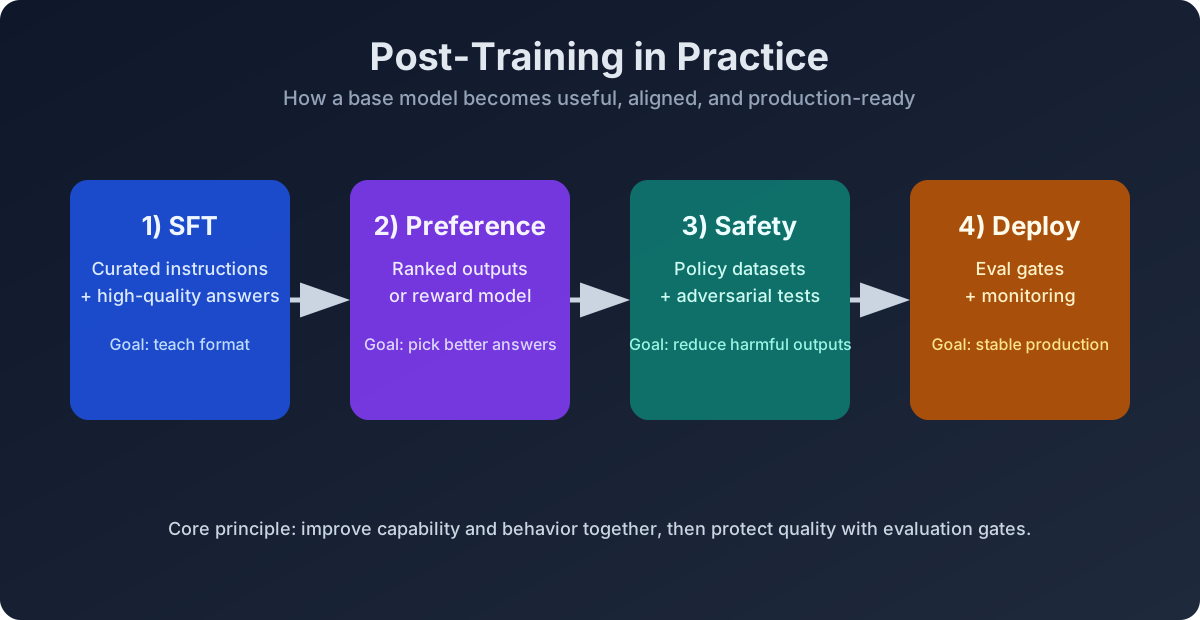
1) What Is Post-Training?
A practical post-training stack usually has three stages:
- Supervised Fine-Tuning (SFT)
- Train on prompt-response pairs written or curated by humans.
- Preference Optimization
- Train the model to choose preferred outputs (e.g., DPO, PPO/RLHF variants).
- Safety + Robustness Tuning
- Add policy/safety datasets and adversarial evaluations.
A concise objective view:
L_total = L_sft + λ_pref * L_pref + λ_safe * L_safeWhere:
L_sftteaches instruction following,L_prefpushes the model toward preferred responses,L_safepenalizes unsafe or policy-violating behavior,- and
λvalues control trade-offs.
2) The Core Equations (No PhD Required)
2.1 SFT Loss (token cross-entropy)
L_sft = - Σ_t log p_θ(y_t | x, y_<t)Intuition: maximize probability of the correct next token in the reference answer.
2.2 Preference Loss (DPO-style intuition)
For a prompt x, preferred answer y+, rejected answer y-:
L_pref = - log σ(β * [log π_θ(y+|x) - log π_θ(y-|x)
                      - log π_ref(y+|x) + log π_ref(y-|x)])
Intuition: make preferred answers relatively more likely than rejected ones while staying anchored to a reference policy.
2.3 Safety-Constrained Objective
maximize   Helpfulness(θ)
subject to UnsafeRate(θ) ≤ ε
Intuition: we do not only maximize quality; we enforce safety constraints.
3) A Production Workflow (Mermaid)
flowchart TD
A[Base model checkpoint] --> B[SFT on instruction data]
B --> C[Preference optimization DPO/RLHF]
C --> D[Safety tuning and red-team data]
D --> E[Evaluation gates]
E -->|pass| F[Deploy]
E -->|fail| G[Data/model iteration]
G --> B
4) Minimal Training Code Example (PyTorch-style)
import torch
import torch.nn.functional as F

# logits: [batch, seq, vocab], labels: [batch, seq]
def sft_loss(logits, labels, ignore_index=-100):
    vocab = logits.size(-1)
    return F.cross_entropy(
        logits.view(-1, vocab),
        labels.view(-1),
        ignore_index=ignore_index,
    )

# logp_chosen / logp_rejected: [batch]
def dpo_loss(logp_chosen, logp_rejected, ref_chosen, ref_rejected, beta=0.1):
    margin = beta * ((logp_chosen - logp_rejected) - (ref_chosen - ref_rejected))
    return -F.logsigmoid(margin).mean()

# combined objective in one training step
def total_loss(logits, labels, dpo_terms, lambda_pref=0.5, lambda_safe=0.2, safe_penalty=0.0):
    loss_sft = sft_loss(logits, labels)
    loss_pref = dpo_loss(*dpo_terms)
    return loss_sft + lambda_pref * loss_pref + lambda_safe * safe_penalty
5) Example Quality/Latency Trade-off Chart
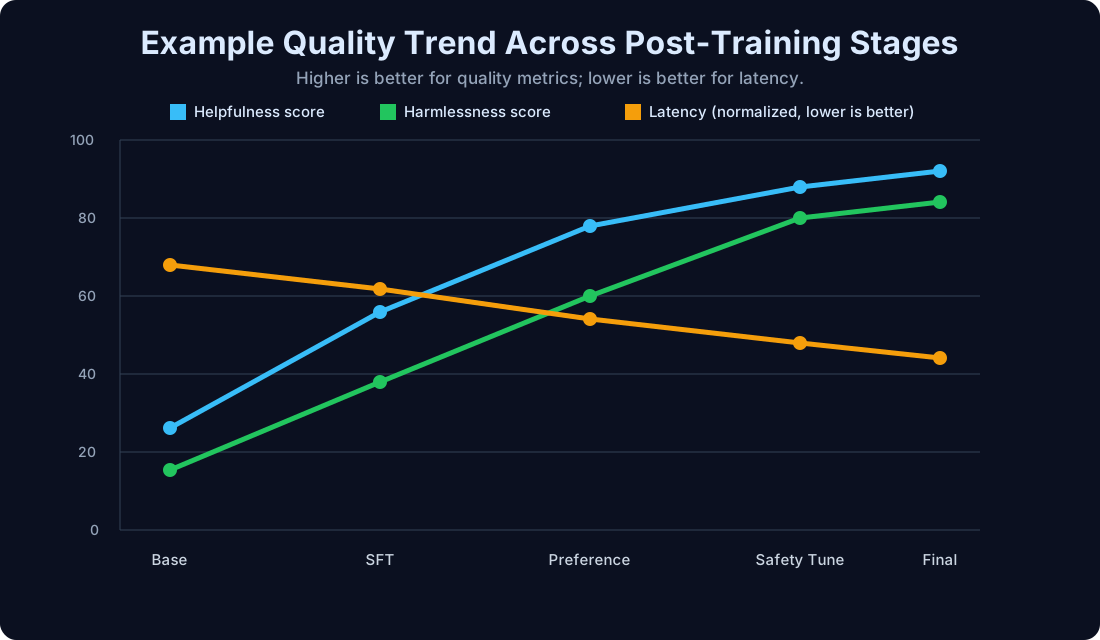
The chart reflects a common real-world pattern:
- Helpfulness improves quickly after SFT and preference tuning.
- Harmlessness improves most after safety tuning.
- Latency can increase as safety and reranking logic gets added.
6) How to Evaluate Post-Training
Use a balanced scorecard instead of one metric:
- Capability: instruction-following accuracy, task success rate.
- Preference alignment: win-rate vs baseline in pairwise evals.
- Safety: policy violation rate, jailbreak success rate.
- Reliability: hallucination rate, citation correctness.
- Efficiency: p95 latency, tokens per response, serving cost.
A practical release gate example:
Ship if:
- WinRate >= +4.0% vs current production model
- UnsafeRate <= 0.5%
- HallucinationRate <= baseline
- p95 latency <= 2.0s
7) Common Mistakes and Fixes
- Mistake: over-optimizing one metric
- Fix: keep hard safety/latency guardrails.
- Mistake: noisy preference labels
- Fix: improve rubric quality and annotator agreement checks.
- Mistake: no segment-level analysis
- Fix: evaluate by language, domain, and user intent buckets.
- Mistake: skipping adversarial tests
- Fix: add red-team suites before every release.
8) Quick Mental Model
Think of post-training as behavior engineering for a pretrained brain:
- SFT teaches structure,
- preference tuning teaches taste,
- safety tuning teaches boundaries,
- evaluation protects users and product quality.
If you build with this loop, your model gets not only smarter, but also safer and more deployable.